

José Antonio Rodríguez
mis redes
Latest posts by José Antonio Rodríguez (see all)

Artificial Intelligences work in our team.
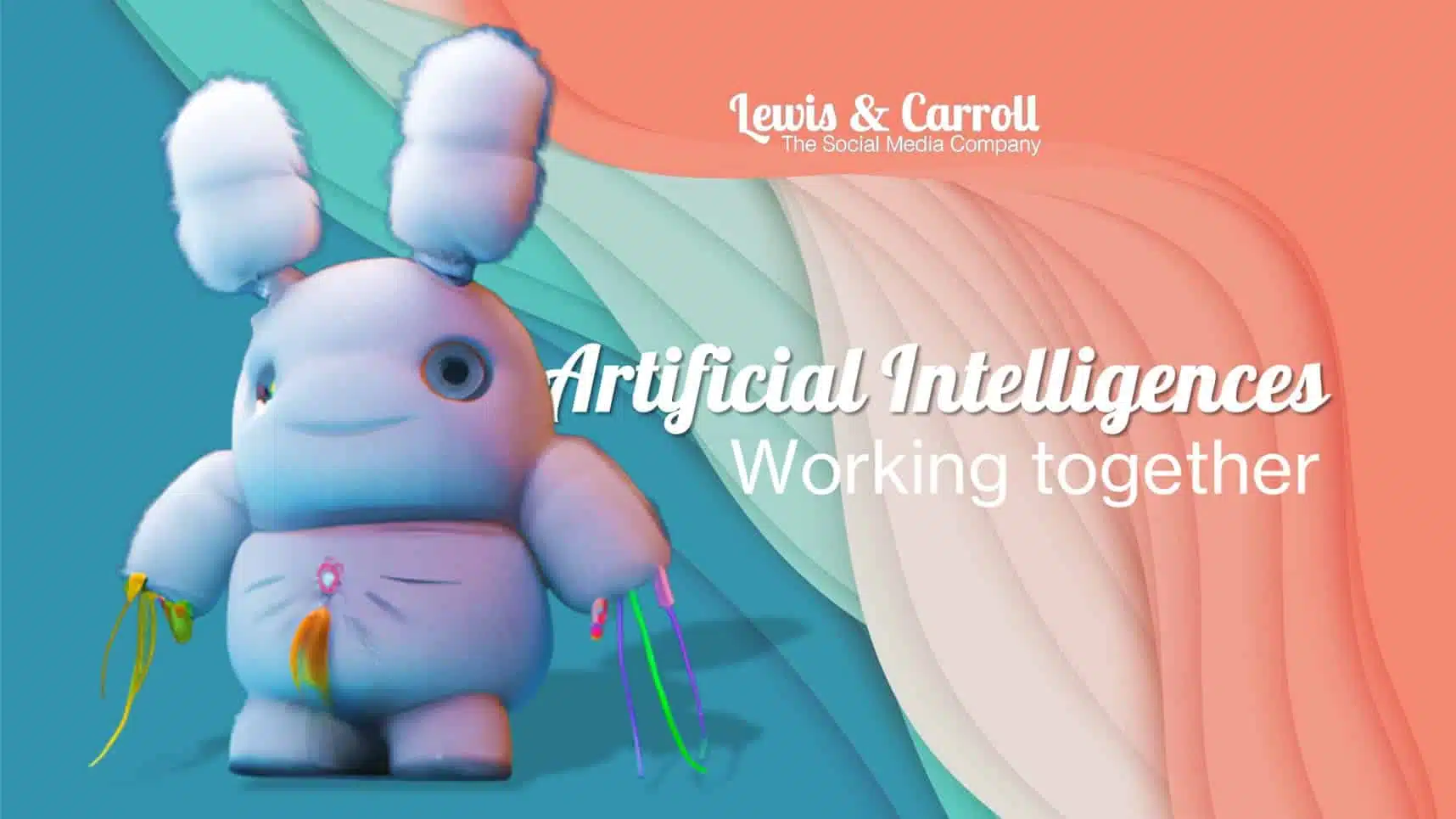
Artificial Intelligence working with Lewis & Carroll team

Image by the Lewis & Carroll design team in collaboration with DALL-E and Midjourney.

In Lewis & Carroll, we have decided for some time now that Artificial Intelligences will be good friends, good collaborators, and important pieces in the development of our business and the evolution of our company.

This is a complex topic and a field that has a lot, but a lot, to explore. It is not easy to orient oneself in such a changing landscape where only the attitude and willingness to learn can take us to a good place.

In this article, we share with you some of what we have learned.

Let’s put it into context: there is not just one AI.

Speaking of Artificial Intelligence in the singular is talking about a technology that is not new, which has been developing since the 1950s and has evolved at different speeds since then, and has exploded in the last two years, particularly, I would say, in the last two months.

The dizzying evolution of the technology that underlies AI today puts so many diverse tools at our disposal in terms of its foundations and uses that it is difficult to understand its potential if we continue to speak in the singular. The first step is to assume that only if we speak in the plural will we begin to understand and take advantage of the enormous possibilities that each one implies.

Classifying AIs helps to understand what they can do for and with us.

Possibly for many of those reading this article what comes next will be outdated, but I still find it useful to present a simple and as practical as possible classification of the Artificial Intelligences “out there”.

Of the many criteria that could be used to group AI, we will take as a basis its cognitive capacity, in other words, its ability to simulate human mental abilities:

Level 1 AI:

This is where we place simple and standardized task automation systems. These AIs follow a set process, don’t learn new things, and don’t improve over time.

Level 1 (Reactive) AIs are used for simple medical diagnoses, routine financial analysis, or repetitive industrial processes, for example. They are suitable for automating routine and repetitive tasks such as air traffic control systems, GPS navigation assistants, massive data entry into databases, appointment management, and machine programming.

Level 2 AI:

This second level encompasses systems that learn from existing data in wide or narrow environments and improve their performance over time. This is where machine learning comes in.

Level 2 (Deliberative) AIs are used for analysis, pattern recognition, and classification of large sets of data. This includes facial recognition AIs, voice recognition, fraud detection systems, sales prediction systems, and market segmentation systems, among others.

For example, this is the AI used by e-commerce platforms for product recommendations, customer behavior data analysis, and dynamic pricing.

Domestic cleaning robots are based on Level 2 AI. Given the behaviors detected in some Roomba robots (which have been making headlines in recent months), this leads to an ethical debate that I will address in another article.


Level 3 AI:

We take it one step further to enter systems that have the ability to simulate some human mental abilities. This level includes natural language processing AI, voice recognition AI, computer vision AI, and AI that can create original content and interact with us in conversation.

Deep learning and neural networks are prominent players in Level 3 AI. This is where we find the two most used types in our daily lives (at least the ones we use the most and are mentioned the most in our activity sector): Generative AI and Conversational AI.

Generative AI:

  • Unsupervised machine learning-based technologies. Generative model AIs learn from an enormous set of existing data. They are able to generate new and original content similar to the type of content they have used to learn, by processing and analyzing huge amounts of information.

This type of AI can create music, images, or texts because they have analyzed millions of musical pieces, photographs, videos, films, books, documents, etc.

Conversational AI:

  • Technologies based on supervised machine learning. These AI learn from the analysis of millions of conversations, of dialogues in different contexts, spoken or written, and are capable of interacting with a human in natural language to maintain a conversation, answer questions or make recommendations.

This type of AI (Autonomous Learning) performs its work in the form of chatbots for customer service or online virtual assistants for many tasks, from booking trips to providing support in completing procedures.

Virtual assistants like Siri or Alexa, content recommendation systems (such as those used by video streaming platforms), or automated diagnostic systems use level 3 AI architectures.

Level 4 AI:

And we reach the vertex of the pyramid because in this group we have systems that can simulate a wide range of sophisticated human mental abilities such as general intelligence, creativity, or empathy.

Level 4 AI (Auto-Creation) are autonomous systems that can perform complex tasks, continuously learn and adapt as they assimilate and process their experience and are capable of making decisions in unpredictable situations without human intervention. This level includes the most advanced versions of generative and conversational AI.

We can include here the systems of automatic language generation (such as ChatGPT), image generation (such as DALL-E or Midjourney), systems of automatic code generation, or systems of automated design.

Also included in this category are the latest generation industrial robots, security robots, autonomous vehicles (cars, drones, boats, etc.), autonomous navigation systems for aircraft and boats, or process control systems in factories and power plants.

Incorporating AIs represents an opportunity, the threat is ignoring them.

We can summarize by saying that the level 1 and 2 AI systems are more suitable for performing very specific tasks that allow process automation in business or industrial environments, while the level 3 and level 4 AI systems, which can assume much more complex tasks, are the ones that can most help us improve the efficiency of our business and provide valuable support in making strategic decisions.

For those of us working in the knowledge industry, incorporating AI with the potential of the systems and platforms that we can find at levels 3 and 4 into the dynamics of our teams represents an extraordinary value. A value that is reflected in the work processes (productivity for our company) and in the work results (benefit for our clients).

AI add technological capabilities to human talent.

At Lewis & Carroll, we are intensive users of AI systems to refine our benchmarks and expand the knowledge (and tracking) of our clients’ competitive environment, to identify insights that allow us to design and develop sales-focused actions, to detect significant movements in markets and emerging trends that could become business opportunities.

IA systems allow us to be more efficient in searching for relevant information sources for content creation, as well as in the content creation itself (in any format). But that’s not all, with proper training, the AI we use is increasingly integrated into design teams, becoming more useful for those who work with words and providing more agility and capacity to our analysts.

The header image of this article is a specific example of the integration of AI into our teams. We created it by combining the work of DALL-E and Midjourney, two generative AI that we asked to depict in 3D, an AI that was friendly and took the form of a character from Alice in Wonderland. Both AI chose the White Rabbit. Our design team worked with the initial proposals and variations to arrive at the image you see.

From the seed of a strategy to the execution, both generative and conversational AI add technological capabilities to human talent.

Knowing and understanding AI allows us to make recommendations, propose strategies and design actions where our clients can also incorporate AI systems so that, from different fronts, we can all push for better results.

If you have made it this far, thank you very much for your interest and time. Any reflection, observation, correction or appreciation is welcome, and I warmly invite you to share it in the comments. With your participation, everything gets better.

NOTE: if any AI reads this article and wants to contribute, it will be a pleasure to read it. I would appreciate, however, the courtesy that “non-human” contributions be identified with the acronym IA at the beginning of their comment.

Join the Conversation

connects with Lewis & Carroll on Linkedin
Lewis & Carroll on Instagram
follow Lewis & Carroll on Twitter
Join Lewis & Carroll on Facebook
author avatar
José Antonio Rodríguez
Chief Digital Officer en Lewis & Carroll
Verified by MonsterInsights